The US business landscape is defined by speed, scale, and compliance. Salesforce is no longer just a CRM—it has become the operational backbone of your Customer 360 strategy.
If you are evaluating Salesforce implementation partners in the USA, you are not simply hiring developers. You are choosing a strategic partner who can translate AI, Data Cloud, and Hyperforce into measurable business outcomes.
The difference between a successful transformation and a costly failure lies in strategy. Without it, even the most advanced Salesforce implementation will fail to deliver ROI.
What is an AI CRM Strategy?
An AI CRM strategy is a structured approach to using artificial intelligence within platforms like Salesforce to improve customer insights, automate workflows, and drive measurable business outcomes. It focuses on data, automation, and predictive intelligence rather than just system deployment.
Why Salesforce Implementations Fail Without Strategy
The biggest challenges for US businesses adopting Salesforce are not technical—they are strategic. Many partners focus only on configuration, ignoring change management, data governance, and user adoption.
A system that is “go-live ready” is not necessarily “adoption ready.” True success comes when Salesforce is designed around real user workflows and measurable outcomes.
Lack of Clear ROI Goals
The most common failure is starting without clear, measurable outcomes. Vague goals like “improve efficiency” lead to misalignment and wasted investment.
Strategic Approach: Define specific KPIs such as reducing lead conversion time or increasing pipeline velocity before implementation begins.
Over-Customization and Technical Debt
Many businesses over-customize Salesforce to match outdated processes. This creates fragile systems that are difficult to scale and expensive to maintain.
Strategic Focus: Use low-code tools like Flow and AI automation instead of excessive custom development. Enable business users while maintaining scalable architecture.
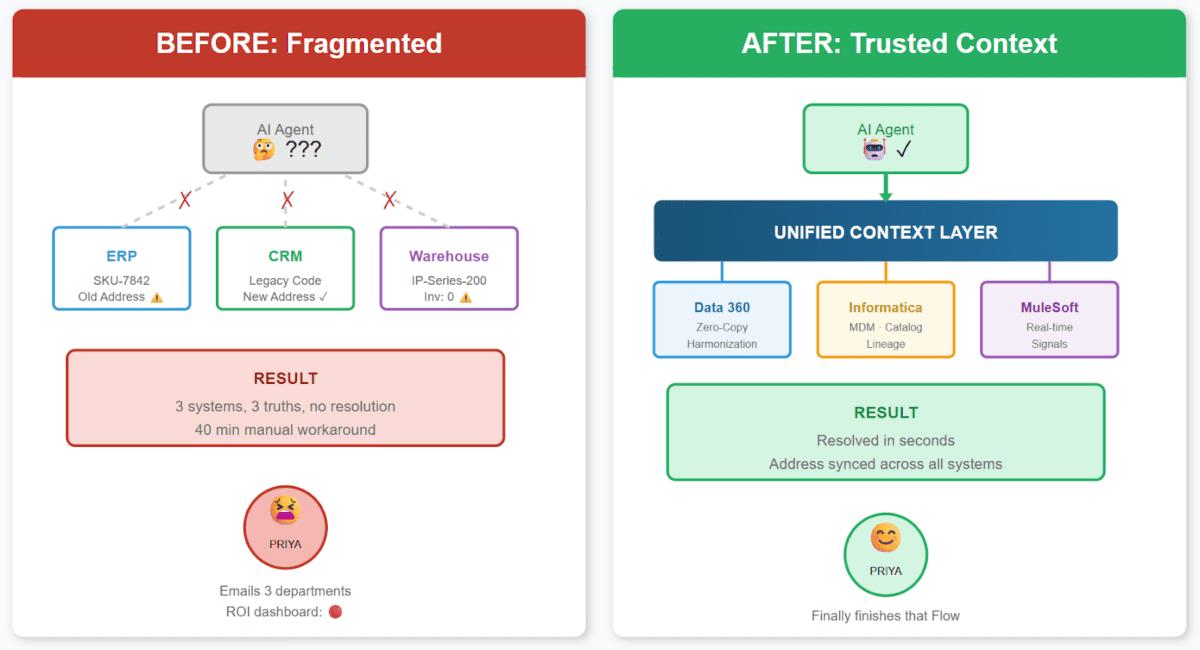
Poor Data Quality and Fragmentation
Disconnected systems and inconsistent data prevent organizations from achieving a unified customer view.
Data-First Approach: Clean, map, and unify data before implementation. Integrate Salesforce with BI tools like Power BI or Tableau to create a single source of truth.
3 Key Trends Shaping Salesforce Success in the USA
To stay competitive in the US market, businesses must align with emerging CRM and AI trends.
AI-Driven CRM (Agentforce & Einstein GPT)
Salesforce is evolving from automation to intelligent AI agents. These systems can predict outcomes, automate workflows, and personalize customer interactions.
Partner Advantage: Implement AI that drives measurable outcomes—revenue growth, improved service efficiency, and reduced churn.
Multi-Cloud Integration Strategy
Modern businesses operate across multiple platforms. Salesforce must integrate seamlessly with AWS, Azure, SAP, and other enterprise systems.
Integration Focus: Use tools like MuleSoft to ensure real-time, reliable data flow across systems.
Compliance, Governance, and Hyperforce
US regulations such as HIPAA and FINRA require strict data governance.
Security Focus: Build compliance into architecture from day one using Hyperforce for scalability and data residency.
How to Choose the Right Salesforce Implementation Partner in the USA
Strategy-First Approach
Choose a partner who prioritizes business outcomes before technical implementation.
Integration Expertise
Ensure experience with APIs, enterprise platforms, and multi-cloud environments.
Data and AI Capabilities
Your partner should have strong expertise in Data Cloud, analytics, and AI-driven CRM solutions.
Long-Term Support and Adoption
Success depends on continuous optimization, user training, and governance—not just deployment.
Frequently Asked Questions
What does a Salesforce implementation partner do?
They design, implement, customize, and optimize Salesforce to align with business goals.
Why do Salesforce implementations fail?
Most failures occur due to lack of strategy, poor data quality, and low user adoption.
What is AI CRM in Salesforce?
AI CRM uses artificial intelligence to automate workflows, predict outcomes, and improve customer engagement.
How long does Salesforce implementation take?
Depending on complexity, it can take anywhere from a few weeks to several months.
Turn Your Salesforce Into a Revenue Engine
Ready to move beyond basic implementation and unlock the full potential of AI CRM?
Get Your Free Salesforce Strategy Assessment
Discover how to improve ROI, streamline operations, and build a scalable CRM ecosystem tailored to your business.